

FEMA PODs: What They Are & Why They Matter

FEMA is the acronym for the Federal Emergency Management Agency, an agency that responds to and mitigates disasters. PODs stand for Points of Distribution. PODs are planned methods to distribute emergency supplies. They would be needed if the infrastructure broke down, where food, water, and other supplies could not be distributed through normal means.
Contents (Jump to a Section)
This is an updated article on FEMA PODs. Our first article was several years ago (pre-COVID), and we will continue to update this article when any information changes or develops related to Points of Distribution.
What is a FEMA POD?
The Army Corps of Engineers and FEMA have teamed up to develop general plans for resource dispersal using local agencies in the event of a national disaster. The POD is the designated location and the process where they distribute the resources.
They are designed in three sizes to accommodate different traffic, the largest of which is no more than 20,000 people a day.
What Resources Would a FEMA POD Distribute?
Besides regular disaster supplies such as food, water, and blankets, a FEMA POD could also be called upon to distribute the Strategic National Stockpile (SNS). The SNS is a huge stockpile of medical supplies maintained by the Centers for Disease Control and Prevention (CDC). The medical supplies include vaccines, antibiotics, antidotes, and antitoxins for rapid deployment to PODs.
The SNS would be used in response to a biological weapon, epidemic, or pandemic. The supplies from the SNS would be signed out by individuals to prevent waste. Disaster supplies like food and water would usually be distributed so that each person or vehicle gets enough for a family of three. Many times, these are provided as MREs and ice.
Here is a video going into more depth:
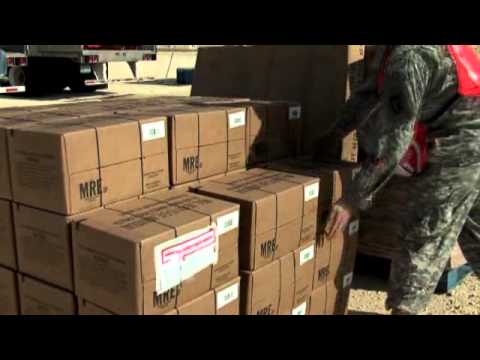
Where are the PODs Located?
Locations are not concrete but depend on local officials to pick the location to ensure that it is a safe and accessible area. Many of these locations have been pre-planned locally as part of their ERP (Emergency Response Plan).
Barring having contact with FEMA, there is no surefire way to predict where the POD will be set up in your local area. Public schools make good POD location areas due to how their locations are dispersed in the population. Hospitals are usually not selected as POD locations because it would cause traffic problems.
If PODs are needed, hospitals would most likely be at capacity due to the disaster event. The location selected will be based on the type of disaster in the local area and accessibility for both survivors and resupply trucks.
How Would I Get Resources From a FEMA POD?
The point of dispersal would most likely run supplies from 7 am to 7 pm, and then restock after that shift is over. Security will be present to usher crowds and keep everyone calm. If you are visiting a FEMA POD to get vaccines, it is a good idea to wear personal protective equipment. An N95 mask and nitrile gloves should be your bare minimum if you have to wait in an area with possibly infected people for long periods.
The plans for setting up a POD are fairly optimistic since they are hoping that vehicles will be used to pick up supplies and rotate people through the area faster. If vehicles are not able to be used, then the resources will not be able to be distributed very fast, and wait times will increase quickly.
What’s Important About FEMA PODs?
In an event where you need disaster supplies, you are going to need to know how to obtain them through your local POD. While you may have disaster supplies covered if you are a seasoned prepper, activation of the Strategic National Stockpile could change this. The vaccines and treatments in the SNS would be needed by the entire population.
A FEMA POD could hold the key to survival through its distribution of these vaccines in the event of a pandemic. Reaching a POD without infection and limiting your exposure while obtaining the vaccines could be the most important part of your disaster response. Be aware of the potential for crowd-based disasters, since groups of panicked people are not the most predictable.
Where to Learn More
If you want to learn more, you can learn straight from the source on the FEMA website. Here are the resources they provide to teach local and federal emergency managers:
- FEMA POD Training Sheet – A one-page overview of the POD program.
- FEMA POD Course Overview – This is the training course overview for POD Managers. Tons of information about organization, layouts, and operation.
- Online Course IS-26: Guide to Points of Distribution – A four-hour training course that anyone can take, including you!
You could even go so far as to get a certificate by taking a test, but there are better uses of your time if you aren’t a local emergency manager or part of FEMA.
The Final Word
Thanks for taking the time today to learn more about FEMA PODs’ role in the National Incident Management System (NIMS). Even when you plan to be self-sufficient, like many preppers, it helps to know the plans in place and how government agencies will react to different situations. If you found this article helpful, you may also enjoy:
- 6 Ways to Avoid Being Herded into a FEMA Camp
- 75 Survival Acronyms and Terms Every Prepper Should Know
- Home Survival Kit List | 53 Essentials
Keep exploring, stay prepared, and be safe.
See more of our expert-written guides, resources, and reviews in your search results – add TruePrepper as a preferred source.
Prepping Your Way
No judgement and no imperatives. Prepare the way you want to with the trusted source millions of modern preppers have relied on.Our newsletter fires out every Monday where you can expect:
- Practical prepping guides and tips
- Thorough survival gear reviews
- Noticeably absent spam and popups
- < 0.4% of people unsubscribe


I just read your article about F.E.M.A. camps. It told me that you should NOT ask for assistance from F.E.M.A. .
SO DO YOU CONSIDER F.E.M.A. to be an evil agency or a good one?
Don’t put yourself in a position to need help from FEMA. FEMA is not an ‘evil agency’- its just some government workers doing their jobs. I’ve been to classes with FEMA folks and they’re just regular people living regular lives. The problem is the system: FEMA is a catch-all for the unprepared and/or unlucky. The bottom line is that a FEMA camp is not a place you want to end up when SHTF.
I have wondered why the fence outside of a FEMA Camp has barbed wire facing in instead of facing out. Doesn’t that mean to keep in instead of keeping others out?