


Best Fire Pistons for Firestarting

There are many better and easier options for starting a fire than a fire piston, but what’s the fun in that? Sure, matches and lighters are easy to use, but they can’t create a spark out of thin air. Fire pistons are a marvel, and that explains why you’re just as likely to see them in science class as in a survival kit. They work by rapidly compressing air, similar to a diesel engine’s compression. There aren’t a huge number of fire pistons to pick from, but that doesn’t mean they are all made equally.
This is where we come in. We’ve researched the best fire pistons, compared them, and now the results are in: the overall best, a beginner option, and an upgrade option. If you need a compression fire starter, one of our picks will bring the heat.
Contents (Jump to a Section)
In this latest update of the best fire pistons, pricing has been updated, and more pictures have been added.

Best Fire Piston
Campfire Hickory Piston
Large Chamber, Easy, and Reliable
Best for: Bushcraft & Survival
*Price at time of publishing; check for price changes or sales.
This fire piston is one of the larger ones we tried, which gave it a leg up. Besides the ergonomic hickory handle, this piston was the easiest to use by far because it had high compression volume paired with precise machine quality.
Specifications
- Materials: Aluminum chamber and piston, hickory housing
- Includes: char cloth, spare O-rings
- Size: 4.5″ L x 0.875″ D
- Weight: 2 ounces
Needing less lubricant and providing consistent embers make this one rise above the other pistons in survival scenarios.
It’s a reliable, effective, and easy-to-use fire starter, so it’s clear why this Hickory Fire Piston is the best.

Budget Fire Piston
PSKOOK Fire Piston
Comprehensive, Inexpensive, and Effective
Best for: Beginners
*Price at time of publishing; check for price changes or sales.
This mid-sized pocket piston comes at a rock-bottom price. It’ll get the job done and comes with everything and the kitchen sink put together as a ‘fire piston kit’.
Specifications
- Materials: Aluminum chamber, copper piston
- Includes: instructions, char cloth, jute fiber, lubricant, paracord, spare O-rings, and storage tin
- Size: 5″ L x 0.67″ D
- Weight: 4.4 ounces
Don’t worry about stocking up on Vaseline, char cloth, and other tinder because this kit comes with plenty. This makes it ideal for stashing in kits or as a gift for that survivalist (or physicist) friend of yours.
If you are looking for an inexpensive but complete option, the PSKOOK Fire Piston is what you need to try a new fire-starting method.

Upgrade Fire Piston
TiSurvival Stonewash
Precise, Effective, and Lightweight
Best for: Keepsake Durability
*Price at time of publishing; check for price changes or sales.
This custom titanium fire piston has slim machining tolerances for fast fires. It includes everything you need to get started and to keep you going with maintenance items, too.
Specifications
- Materials: Titanium chamber and piston
- Includes: Char cloth, jute cord, spare O-rings
- Size: 4.2″ L x 0.8″ D
- Weight: 4.5 ounces
I’m a big fan of the machined notch to hold the combustible materials, rather than a hollow tip. This makes it much easier to use, since it protects the ember once it’s lit.
You don’t have to worry about your char cloth sliding up into O-rings because the machining tolerances are already very good on these- there is no wiggle room for binding.
If you are looking for a quality solution, grab a TiSurvival Stonewash Titanium Fire Piston.
Comparison Table
| Fire Piston | Recommendation | Price* | Piston Size | Best Feature |
|---|---|---|---|---|
| Campfire Hickory | Best Overall | $29 | 4.5″ x 0.9″ | Ergonomics |
| PSKOOK Kit | Best for Beginners | $22 | 3.8″ x 0.5″ | Inexpensive price |
| TiSurvival Stonewash | Best High-Quality Piston | $150 | 4.2″ x 0.8″ | Heirloom-quality durability |
The Pistons We Compared
Our research narrowed the field down to several brands and types of pistons that we compared: Wilderness Solutions, SXTL, Coherny, American Heritage, Ti Survival, and more.
You can see our full list of review criteria below in the What to Look For section, with an explanation for each.
We considered almost every fire piston we could get our hands on. They used a wide range of materials and come in several sizes. We reduced our comparisons to pocket pistons, although larger pistons can have more reliable ignitions due to larger compression chambers.
There is one smaller model masquerading as many brands (presumably due to dropshipping), but it is easily recognizable with two O-rings on the end of the small compression cylinder. It did not perform well in our tests.
We’re always looking for new and better solutions, so if you have a fire piston that you swear by, let us know in the comments. We review most of our tested equipment annually, so we can try to get it in the next roundup and see if it will beat out our top picks.
What to Look For
The best fire pistons have a few features to look for:
- Value
- Precision Quality
- Compression Volume
- Size & Weight
- Durability
When you get the right blend of these, you can find a piston that will consistently compress to generate plenty of heat. Below, we break down what each of these features means for the fire pistons that truly set themselves apart.
Value: Cost vs. Benefit
The amount of money you spend on something like a fire piston shouldn’t blow out your entire budget. Fire pistons are not cheap as far as fire starters go, whereas you can get matches, lighters, ferro rods, and more for cheaper.
You never want to spend too much money on one thing when it comes to survival gear. It’s better to diversify your equipment and budget to make sure you are covered for a wide range of scenarios.
Precision Quality
Friction during the compression of a fire cylinder fights against you, making an ember. But you need friction to keep a good seal as the chamber is compressed to compress the air inside it instead of allowing it to escape.
Many of the brands we tested address this with multiple O-rings (instead of one) and plenty of lubricant (petroleum jelly).
We found that when the compression cylinder and piston are machined precisely to be closer fits, you need fewer O-rings and lubricant to be effective. Larger fire pistons worked better as well, presumably because we were compressing more air.
Compression Volume
The size of the compression chamber can be measured approximately by the piston rod. When it is machined precisely for a good fit, it fits very close to snug and seals well with the help of a single O-ring.
When you compare piston rod sizes between different fire pistons, you can see approximately how much air is being rapidly compressed. Since you are using the same motion to compress these, more air compression equals a larger energy transfer into heat.
Size & Weight
While larger pistons can get hotter, you don’t necessarily need that if you are lighting char cloth and other easily ignitable tinder. Size can be a hindrance if you plan on keeping it in your pocket or in a kit.
Most of the pistons we compared weigh just a few ounces, so this isn’t an issue for our suggestions, but it could be if you insist on carrying a diesel cylinder around with you.

Durability
The durability of the fire pistons mostly came down to their consumable parts: the O-rings. When you get a pocket piston, you aren’t getting medical or industrial-grade O-rings, so we did find them dry-rotting and degrading over time, with friction and ignitions. A few of the options we suggest provide spares, acknowledging that the O-rings are a consumable part.
Lubricants were also needed- damage to the pistons and chambers can happen. We had some marring on our brass piston after many uses. The material type contributes, as we compared fire pistons with chambers and pistons using everything from brass to titanium.
How to Use a Fire Piston
Fire pistons are easy to use, but do require some prep work and maintenance. O-rings are harder to come by, so you’ll want to make sure you treat them well with lubrication. The type of tinder you select will also determine how easily the fire piston can ignite it.

Here are the general steps to use a fire piston:
- First, you’ll need to pull the piston out of the compression chamber. Inspect the O-ring to make sure it is intact.
- Lubricate the O-ring area with petroleum jelly if needed, but keep the jelly away from the tip.
- Next, carefully add some tinder to create an ember inside the tip of the piston. It should stick out slightly. Char cloth works exceptionally well, and you only need to tear off the size of a fingernail and wad it up.
- With the tinder in position, insert the tip of the piston into the chamber just past the O-ring.
- Next, holding the handle of the piston, rapidly press the piston into the chamber (you can slam it against something hard like a tree, but don’t break it!)
- Carefully remove the chamber from the piston, being sure not to drop the ember from the tip of the piston rod. Blow on the ember lightly to make sure it ignites fully. Transfer the ember to a bird’s nest to start a fire.
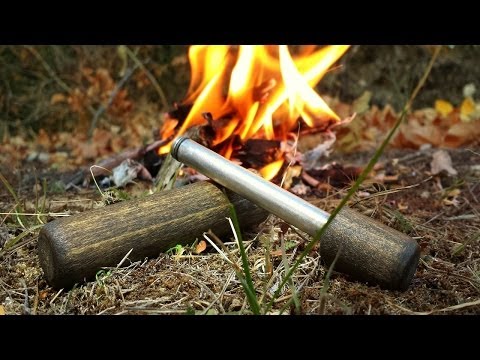
John does a great job of explaining compression pistons and specifically walks through our top pick:
Who Needs a Fire Piston?
Fire pistons are a niche fire starter, similar to a magnifying glass. For survival, we regularly rely on lighters, matches, and ferro rods. But just like magnifying glasses, that doesn’t make learning new fire skills useless.
Fire pistons can be considered for these kits:
Besides using them for survival, compression pocket pistons are useful in demonstrating and teaching physics.
Sources & References
All of our experience and the testing we do to determine the best fire piston are useless without listing our research sources and references. We leaned on these for the book knowledge that we paired with our hands-on testing and practical survival experience:
Fox, R. (1969). The Fire Piston and Its Origins in Europe. Technology and Culture. Volume 10. Issue 3. Pages 355 – 370. (Source)
Güémez, J., et al. (2007). Physics of the fire piston and the fog bottle. European Journal of Physics. Volume 28. Issue 6. Page 1199. (Source)
Denker, J. (2010). Fire Pistons. The Physics Teacher. Volume 48. Issue 3. Page 207. (Source)
Conclusion
Fire pistons are clever little tools that accomplish what seems impossible- using air compression to generate enough heat to create an ember. While they aren’t the most practical fire starters, they are certainly worth learning and having as a backup.
Here are a few other guides and reviews our subscribers have found helpful:
- Best Char Cloth to Start Your Fire
- The Best Ferro Rod for Survival Fire Starting
- Bug Out Bag List | 44 Essentials
See more of our expert-written guides, resources, and reviews in your search results – add TruePrepper as a preferred source.
Prepping Your Way
No judgement and no imperatives. Prepare the way you want to with the trusted source millions of modern preppers have relied on.Our newsletter fires out every Monday where you can expect:
- Practical prepping guides and tips
- Thorough survival gear reviews
- Noticeably absent spam and popups
- < 0.4% of people unsubscribe
