


The 7 Biggest Nuclear Warheads Ever Detonated

Big nukes are like dinosaurs- they’ve made their mark on history and will likely not be seen again. The sheer power and destruction these high-megaton monsters could cause is mind-boggling, but it seems like it is better that countries are not racing for the biggest nuclear payload these days. That may sound reassuring, but it is not necessarily better that striving for that megaton payload is not the goal.
The evolved delivery systems have made nuclear weapons precision-targeted rather than giant ‘dumb’ bombs. Before we get too far into that, let’s get to the list of the monsters of destruction, the seven biggest nuclear warheads ever detonated:
7. Mark-36 (10 Megatons, USA, 1956)
Based on what was learned from the Shrimp bomb (the first dry-fuel thermonuclear bomb), the Mark-36 was developed. The US made almost 1000 Mark-36 two-stage nuclear warheads. They were designed to be carried by large bombers, such as the B-47 and B-52.
The bombs weighed around 17,500 pounds, were over 12 feet long, and over 4 feet in diameter. Because the blast was so big, they were equipped with parachutes to allow the bombers to get further away before detonation.
Many of them went on to be repurposed into Mark-21 bombs, which had a small 4-megaton payload in comparison. The rest were converted to Mark-41 bombs, with a much higher yield.
6. Ivy Mike (10.4 Megatons, USA, 1952)
Part of “Operation Greenhouse”, Ivy Mike was a stationary weapon detonated from scaffolding. It was used to research nuclear bombs and was a proof of concept. This is the earliest bomb on the list by far and was a crucial stepping stone to the United States’ nuclear dominance.
This concept was very important in creating larger payload bombs- fusion. It was the first full-scale test of a thermonuclear device, called the hydrogen bomb. Later, a simplified and lighter deliverable version was developed.

5. Mark-24 “Yankee” (13.5 Megatons, USA, 1954)
In May of 1954, the Yankee prototype of the Mark-24 bombs was detonated as part of the Castle tests. Following the Ivy Mike tests, the Mark 24 was the first mass-produced thermonuclear hydrogen bomb.
The bombs weighed about 41,000 pounds, were over 24 feet long, and slightly over 5 feet wide.
Deemed a success, they went on to make over 100 more of the Mark-24 thermonuclear warheads for the nuclear arsenal.
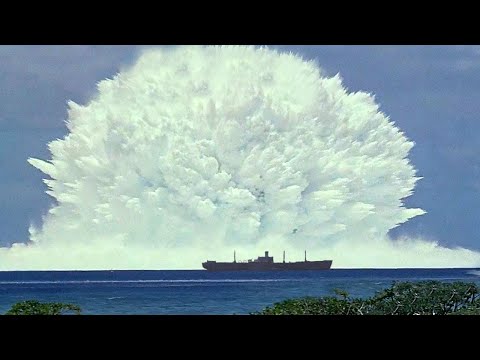
4. TX-21 “Shrimp” (14.8 Megatons, USA, 1954)
“Shrimp” was a part of the infamous Castle Bravo tests at Bikini Atoll. From its detonation spot in the Marshall Islands, radioactive material was detected in parts of Australia, Asia, Europe, and even the US. This is partly because it was detonated only 7 feet above the ground.
This low of a detonation is technically a ‘ground impact’ and results in less destruction but a significantly higher amount of fallout.

3. Mark-17 (15 Megatons, USA, 1955)
Carried by B-36 bombers, this bomb weighed the most of any in the US arsenal at 42,000 pounds. America produced about 200 of these big boys, and they didn’t last very long. Lighter and more effective bombs only kept them active for about 3 years.
One Mark 17 was accidentally dropped from a B-36 near Kirtland Air Force Base in New Mexico on May 27, 1957. The bomb detonated, but did not have a nuclear chain reaction due to separately stored plutonium pits.
2. Mark-41 (25 Megatons, USA, 1958)
America made the second-largest bomb- and not just one. We made over 500. There were two distinct types of the Mark-41, where one model was “dirty” with a uranium casing, which would cause a significant amount of fallout.
The first prototype of this bomb was dropped in 1958 in a test code-named “Operation Hardtack.” Not to be confused with the survival bread. The high yield was achieved using a three-stage system.
The yield-to-weight ratio was the best developed by the United States, with the warhead merely weighing 10,670- easily carried by B-52s and B-47s.
1. Tsar Bomba (50 Megatons, Soviet Union, 1961)
With a much bigger payload than any other warhead on this list, the RDS-220 hydrogen bomb has earned its spot. The Soviet Union dropped this from a bomber in October 1961 over the Arctic Ocean.
The bomb was specially made with three stages instead of the typical two, and the payload was reduced from 100 MT to 50 MT to limit radiation exposure.
It was the first and last of this size detonated, and it’s unlikely we’ll ever see one of that magnitude again. Trailing the US in blast size throughout the entire Cold War nuclear race, the USSR got the last word with this immense bomb.

I Came Upon a Fork in the Road…
The nuclear race was in full swing while the Soviet Union was developing Tsar Bomba. The US completed testing on the Mk-41 three-stage bomb a full three years before the Soviet Union unleashed its 50-megaton creation. America beat the Russians to the moon, so why did they not beat them to the largest nuclear warhead? The answer is simple- tactics. The US figured out that the delivery method of the warhead can be just as important as the payload.
Guided bombs and ICBMs (intercontinental ballistic missiles) entered the picture, making the large ‘dumb’ bombs messy, imprecise, and difficult to deploy. Only one year after the Tsar Bomba, America had the Minuteman ICBM program in place and effectively prevented any attack with this constant threat of counterattack.
The US continued development into the Peacekeeper program, completed in the 80s, and could effectively nuke a ‘smiley face’ pattern into a target with multiple warheads on a single computer-controlled missile. The latest (much improved) version of the original ICBM, the LGM-30 Minuteman III, is still in service today as the only land-based ICBM in the United States.
The Final Word
So why does the rise and fall of high-payload nuclear bombs matter to preppers? It defines the atomic threat that everyone should be prepared for.
An earth-cracking 1000-megaton thermonuclear warhead is not practical or probable, but coordinated ICBM strikes are probable when talking of nuclear war.
Our subscribers have also found these articles helpful:
- Fallout Shelters Near Me | Nuclear Bomb Bunker Locations
- 9 Nuclear Warheads America Lost and Never Recovered
- Nuclear Survival Kit List | 16 Essential Items
Keep exploring, stay prepared, and be safe.
See more of our expert-written guides, resources, and reviews in your search results – add TruePrepper as a preferred source.
Prepping Your Way
No judgement and no imperatives. Prepare the way you want to with the trusted source millions of modern preppers have relied on.Our newsletter fires out every Monday where you can expect:
- Practical prepping guides and tips
- Thorough survival gear reviews
- Noticeably absent spam and popups
- < 0.4% of people unsubscribe

